Spray Drying vs. Thermal Dehydration: Which Preserves Nutrition Best?
Spray drying, tray drying, and thermal dehydration produce different nutritional outcomes. This comparison helps manufacturers specify the right ingredient for their formulation.
When a food manufacturer or ingredient buyer evaluates dehydrated powder suppliers, the spec sheet usually covers moisture content, mesh size, and microbial counts. What it rarely mentions is how the powder was made — and that is a mistake.
The dehydration method directly affects the nutritional value, flavour intensity, colour, and reconstitution properties of the final powder. Two methods dominate the industry: spray drying and thermal (tray/cabinet) dehydration. They work on fundamentally different principles, and they produce noticeably different results.
This comparison is not theoretical. It has practical consequences for anyone formulating food products, marketing health claims, or pricing ingredients based on quality.
How Spray Drying Works
Spray drying converts a liquid feed — typically juice, puree, or extract — into a fine powder in seconds.
The liquid is atomised into tiny droplets and sprayed into a chamber filled with hot air at inlet temperatures between 150°C and 220°C. The water evaporates almost instantly, and the dried particles are collected at the bottom of the chamber. The outlet temperature (where the powder exits) is typically 70–90°C.
The entire process takes 5 to 30 seconds from liquid to dry powder.
Because the feed must be in liquid form, spray drying often requires the addition of a carrier agent — maltodextrin, gum arabic, or modified starch — to help the liquid dry properly and prevent the powder from clumping or sticking to the chamber walls. This carrier typically makes up 10–40% of the final powder weight.
That means a spray-dried “fruit powder” might actually be 60–70% fruit and 30–40% maltodextrin. The label says fruit powder, but a significant portion is filler.
How Thermal Dehydration Works
Thermal dehydration — also called tray drying, cabinet drying, or hot air drying — takes a completely different approach.
Fresh produce is washed, sliced or diced, and spread on trays inside a drying chamber. Warm air at 50–70°C circulates through the chamber, gradually removing moisture over 8–24 hours (depending on the product and slice thickness). Once the moisture drops below 5–6%, the dried product is milled into powder.
No carrier agents. No maltodextrin. No gum arabic. The final product is 100% the original fruit or vegetable — nothing added, nothing removed except water.
The trade-off is time. Thermal dehydration is a slow process compared to the seconds-long spray drying cycle. But that slower, gentler drying preserves more of what matters.
Nutritional Retention: Head-to-Head
This is where the differences become measurable.
Vitamin C
Vitamin C (ascorbic acid) is heat-sensitive and degrades rapidly above 70°C. In spray drying, the inlet temperature exceeds 150°C. While the exposure time is brief, studies consistently show 30–50% loss of vitamin C in spray-dried fruit powders.
In thermal dehydration at 55–65°C, vitamin C losses are typically 15–30%, depending on drying duration and air velocity. The lower temperature makes a measurable difference.
Carotenoids (Lycopene, Beta-Carotene)
Lycopene in tomato powder and beta-carotene in carrot powder are relatively heat-stable, but they degrade under the combination of high heat and oxygen exposure. Spray drying’s high temperatures can cause 15–25% carotenoid loss. Thermal dehydration at lower temperatures preserves 80–90% of carotenoid content in most studies.
Polyphenols and Antioxidants
Beetroot, amla, blueberry, and hibiscus derive their health value largely from polyphenolic compounds. These compounds are moderately heat-sensitive. Research on beetroot shows that drying at 60°C retains significantly more betalain content than drying at 80°C or higher.
Spray drying with carrier agents can encapsulate some polyphenols, potentially protecting them during the drying step. However, the dilution effect of 30–40% carrier means the total polyphenol content per gram of final powder is lower.
Enzymes and Bioactive Compounds
Heat-sensitive enzymes like bromelain (in pineapple) and papain (in papaya) are largely destroyed at spray drying temperatures. Thermal dehydration at 55–60°C retains partial enzyme activity — a relevant consideration for nutraceutical applications marketing enzyme-active ingredients.
Flavour and Aroma Comparison
Anyone who has compared a spray-dried tomato powder side-by-side with a thermally dehydrated one notices the difference immediately.
Spray-dried powders tend to have a milder, sometimes flat flavour profile. The high heat volatilises aromatic compounds — the same compounds that make fresh tomatoes, garlic, ginger, and fruits smell and taste like themselves. The carrier agents further dilute the flavour intensity per gram.
Thermally dehydrated powders are more aromatic and intense. The lower processing temperatures preserve more volatile flavour compounds, and the absence of carriers means every gram is pure product. In taste tests and formulation trials, thermally dehydrated powders consistently require lower inclusion rates to achieve the same flavour impact.
Colour Retention
Colour is a quality indicator that buyers and end consumers both evaluate, often subconsciously.
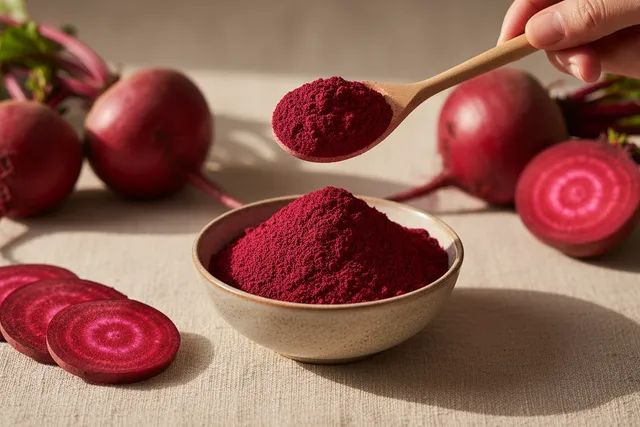
Spray-dried powders are generally lighter in colour — partly due to carrier dilution, partly due to pigment degradation at high temperatures. A spray-dried beetroot powder often appears pinkish rather than deep crimson. A spray-dried tomato powder may look pale orange rather than rich red.
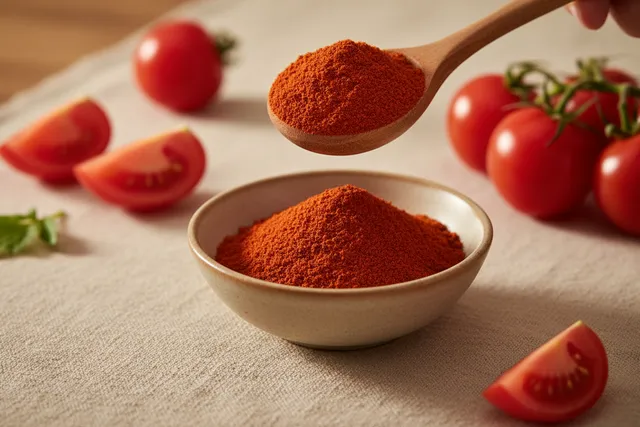
Thermally dehydrated powders retain deeper, more vivid colours. This matters commercially: a deeper red tomato powder commands a higher price and performs better as a natural colourant.
Reconstitution Properties
Spray-dried powders dissolve faster in water. The tiny particle size and the presence of maltodextrin (which is highly water-soluble) give spray-dried products superior instant solubility. For applications like instant beverages where the powder must dissolve completely in cold water within seconds, spray drying has an advantage.
Thermally dehydrated powders take longer to reconstitute. They work well in cooking applications, batter mixes, and hot liquids where a few minutes of mixing is acceptable. For instant drink applications, finer milling (100+ mesh) improves solubility but does not match spray-dried instant dissolution.
Cost Comparison
Spray drying is capital-intensive — the equipment costs crores to install and maintain. But per-unit processing costs are relatively low because of the speed. The carrier agents add to raw material costs but also increase yield (since the carrier adds weight to the final powder).
Thermal dehydration equipment is simpler and less expensive to set up. Processing costs per unit are higher because of the longer drying times and lower throughput. However, since no carrier is used, the final product is pure — which commands a premium price in B2B and retail markets.
For buyers evaluating cost, the real question is: what are you paying per gram of actual fruit or vegetable content? A spray-dried powder at ₹400/kg that contains 35% maltodextrin delivers less product per rupee than a thermally dehydrated powder at ₹550/kg that is 100% pure.
When to Choose Which
| Criteria | Spray Drying | Thermal Dehydration |
|---|---|---|
| Best for | Instant beverages, encapsulated flavours | Cooking ingredients, health products, natural colourants |
| Purity | 60–90% (carrier agents added) | 100% (nothing added) |
| Vitamin retention | Moderate (30–50% vitamin C loss) | Better (15–30% vitamin C loss) |
| Flavour intensity | Mild to moderate | Strong and aromatic |
| Colour | Lighter, diluted | Deep, vivid |
| Solubility | Excellent (instant) | Good (needs mixing) |
| Cost per kg | Lower | Higher |
| Cost per gram of actual product | Higher (diluted) | Lower (pure) |
The Bottom Line
Neither method is universally better. Spray drying wins for applications that demand instant solubility and consistent fine particle size. Thermal dehydration wins for nutrition-focused products, clean-label formulations, cooking ingredients, and any application where flavour, colour, and purity matter.
For manufacturers positioning their brand around “100% natural” or “no additives,” thermally dehydrated powders are the only option that can truthfully back that claim. A product containing 30% maltodextrin is not 100% natural fruit powder, regardless of what the front-of-pack label says.
Know what you are buying. Know what your customers are eating.
ThermDry uses controlled low-temperature thermal dehydration to produce 100% pure fruit and vegetable powders. No maltodextrin. No carriers. No fillers. Just the real ingredient, in powder form. [Explore our product range.]